
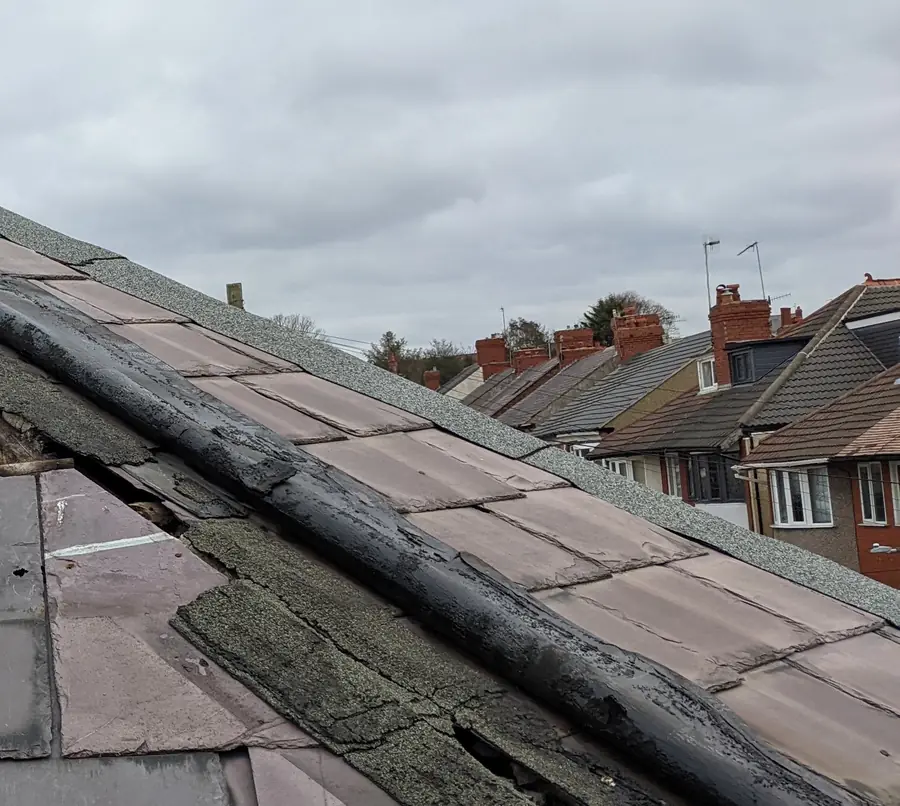
You can check most of these from the ground with binoculars or from the loft with a torch. Stay off the roof. If you spot any of them, ring Kieran for a look and a free written quote, with no call-out fee.
1. Slipped, cracked or missing tiles
Each gap lets rain onto the felt underneath, and the felt was never meant to take it full time. One or two slipped tiles is a small repair. Tiles slipping every winter means the nails or battens have rusted or rotted, and the roof is nearing the end.
2. Damp patches on ceilings
Water that shows on a bedroom ceiling got in somewhere else and ran along the felt or the timbers first. Painting over the stain fixes nothing. Find the entry point: a slipped tile, split flashing, a cracked ridge or a blocked gutter.
3. Daylight in the loft
If you can see light through the roof from the loft, rain gets in the same way. On felted roofs it means the felt has torn or perished. On older roofs built with no felt at all, it means the tiles themselves are moving.
4. A sagging roof line
Look along the ridge and the slopes from across the road. A dip or a wave points to rafters or purlins that have rotted, cracked or been overloaded, sometimes by a heavier tile put on years ago. Get it looked at before it gets worse.
5. Thick moss
Moss holds water against the tiles, the water freezes and the tiles crack. It also washes into the gutters and blocks them. North-facing slopes under the trees in leafy towns like Harpenden and Potters Bar grow it fastest. Roof cleaning clears it and lets the tiles dry out.
6. Blocked or overflowing gutters
Water spilling over the gutter in rain soaks the wall, rots the fascia and finds its way into the brickwork. Leaves, moss and silt are the usual causes. Clear them, and check the joints and brackets at the same time.
7. Cracked ridge or verge mortar
The ridge tiles along the top and the verge at each gable end are bedded in mortar. Once it cracks, water gets in behind and frost pushes the tiles loose. Re-bedding, or a dry ridge and dry verge system, stops it coming back.
8. Split or lifted flashing
Lead flashing seals the joints where the roof meets a chimney, a wall or a dormer. When it splits, lifts in a storm or the mortar holding it falls out, water runs straight down inside. It is one of the most common leaks on older roofs and one of the quickest to fix.
What to do next
Take a photo if you can do it safely from the ground, then ring Kieran on 01727 326610 or send the form. He comes out, finds the cause, explains the options and gives you a free written quote. There is no call-out fee, and all our work is guaranteed.
Related services
- Roof repairs in Hertfordshire
- Emergency roofer in Hertfordshire
- Roof cleaning and moss removal
- Guttering in Hertfordshire
- Leadwork in Hertfordshire
- Roof repair cost in Hertfordshire
Get a real price for your roof
Ranges are a guide. The real number comes from someone looking at your roof. Kieran comes out, shows you what is needed and gives you a free written quote, with no call-out fee.
Questions
How often should a roof be checked?
Once a year, and after any big storm. Autumn is the time, before the leaves fill the gutters and the winter weather arrives.
Can I check my roof myself?
From the ground with binoculars and from the loft with a torch, yes. Stay off the roof itself.
Is a damp patch always the roof?
No. Blocked gutters, chimneys, plumbing and condensation cause damp too. Finding the real cause comes before any repair.